


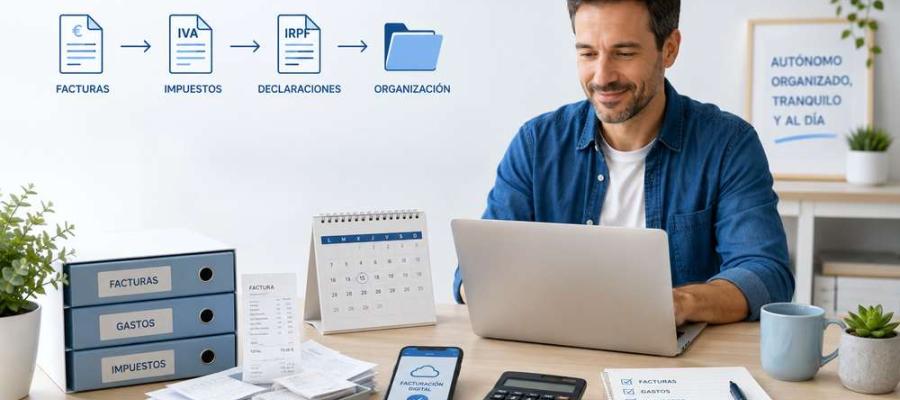

Many small self-employed workers have managed their tax paperwork as best they could: PDFs, receipts in a wallet, business and personal payments mixed together, documents sent to an adviser by WhatsApp and a rushed review every quarter. As tax administration becomes more digital and traceable, the answer is not a complex back office. It is a simple, repeatable system that shows what has been invoiced and collected, what is deductible, what is missing and what tax needs to be set aside.
20 practical ways to simplify tax admin
- Separate business and personal banking. Use a dedicated account for business receipts and payments. A clean statement makes income, costs, unpaid invoices and reviews easier to track.
- Keep one tax folder for each year and quarter. Store issued and received invoices, bank records, Social Security documents, filed returns and questions for the adviser in clear folders. Avoid scattering files across email, WhatsApp, downloads, phones and cloud drives.
- Name files consistently. Use date, supplier or client, and purpose, for example “2026-03-31_Social-Security-contribution.pdf.” Avoid generic names such as “invoice.pdf” or “scan0007.pdf.”
- Sort expenses into clear, uncertain and non-deductible. A properly documented cost clearly related to the business differs from a mixed-use or questionable item. Flag uncertain expenses early and ask about them instead of leaving every decision until quarter-end.
- Save receipts and invoices promptly. Download emailed invoices and file receipts when you incur the expense. A photo of a receipt does not automatically make the cost deductible; for input VAT, a valid invoice may be required.
- Reduce document channels. Documents may arrive by email, bank, app or paper, but they should end up in one central folder, ideally shared with the adviser. The incoming channel can vary; the final archive should not.
- Use straightforward invoicing software. Choose a system that handles numbering, corrections, customer details, exports, payment tracking and organised records. It should suit the business and the invoicing rules that apply.
- Do not automate everything on day one. First organise folders, separate the bank account, choose invoicing software and set a monthly review. Automating a disorganised system simply makes the disorder happen faster.
- Do a 30-minute monthly close. Check invoices issued and paid, unpaid balances, expenses, missing receipts, Social Security, estimated VAT and income-tax payments, and questions for the adviser. Preparing the quarter gradually is less stressful and helps spot problems early.
- Set tax money aside when paid. The whole invoice amount is not available to spend: VAT may need to be paid over, and income-tax payments and fixed costs also need to be budgeted. Reserve money for tax and costs before treating the remainder as cash available.
- Keep a short list of regular business expenses. Depending on the activity, this may include accountancy, software, web hosting, professional phone and internet, office supplies, advertising, relevant training, insurance, workspace rent, bank charges, equipment, justified travel or professional-body fees. Tailor the list and keep evidence of the business link.
- Be cautious with mixed-use costs. Phones, internet, cars, meals, travel, home utilities, computers, clothing, gifts and subscriptions may have personal and business use. Ask whether you can prove the business connection and what proportion is attributable to work; full, partial or no deduction may be appropriate depending on the evidence.
- Distinguish current expenses from capital items. Ordinary running costs differ from assets used for several years, such as computers, furniture, machinery or professional equipment. Flag substantial purchases for the adviser rather than automatically treating them as immediate expenses.
- Prepare for e-invoicing proportionately. Check whether your invoicing program will adapt to the applicable electronic invoicing requirements and allow data exports. Avoid buying an oversized system out of fear, but move away from improvised manual invoices.
- Do not confuse e-invoicing with VERI*FACTU. E-invoicing concerns invoice formats and exchange between businesses. VERI*FACTU concerns invoicing-software requirements such as integrity, traceability and record preservation. You do not need to master every technical detail, but ask your provider whether its system will comply with the rules that apply to you.
- Make working with your adviser easier. Use a shared folder, a regular upload date, clear file names, complete bank records and a short list of questions. The adviser’s time is better spent reviewing and preventing problems than searching for missing files.
- Use a simple monthly control sheet. Track invoices issued and collected, unpaid bills, main and uncertain expenses, estimated VAT and income tax, missing documents, questions and cash-flow expectations. A spreadsheet or even paper is enough if used consistently.
- Check electronic notices regularly. Set a weekly time to review Tax Agency and Social Security notifications, or arrange for an authorised adviser to handle them with a clear alert process. Timely attention helps avoid missed deadlines and unnecessary surcharges, penalties or appeals.
- Choose the correct tax setup from the start. Obligations depend on the activity, VAT regime, income calculation method, employees, premises, cross-border services and sales, withholding and exemptions. Confirm the right registration, activity code, regime and filing obligations before the first invoice.
- Ask before an unusual transaction. Buying or selling an asset, hiring, working for a foreign client, receiving platform payments or grants, changing countries, charging an advance, invoicing without VAT or buying foreign services can have tax consequences. If it is outside your normal routine, ask before acting.
Conclusion
A small business does not need a complex administrative structure. It needs a simple, stable system: a separate business account, one organised archive, suitable invoicing software, a monthly review, money reserved for taxes and clear communication with an adviser. The goal is to work calmly, understand what is being done and be able to support it with records. For a small self-employed business, simplification is not just convenience; it is protection.
Official references: Spanish Tax Agency information on invoicing systems and VERI*FACTU.




I had a really urgent problem in the middle of the summer that I needed to get fixed. I tried contacting a bunch of agencies but they were either unavailable, slow, had terrible service or were crazy expensive (one company quoted me 1000€!). Josep replied to me within 10 minutes and managed to submit my forms on the deadline and all for a great price. He saved my life - 100% recommend!